
Introduction
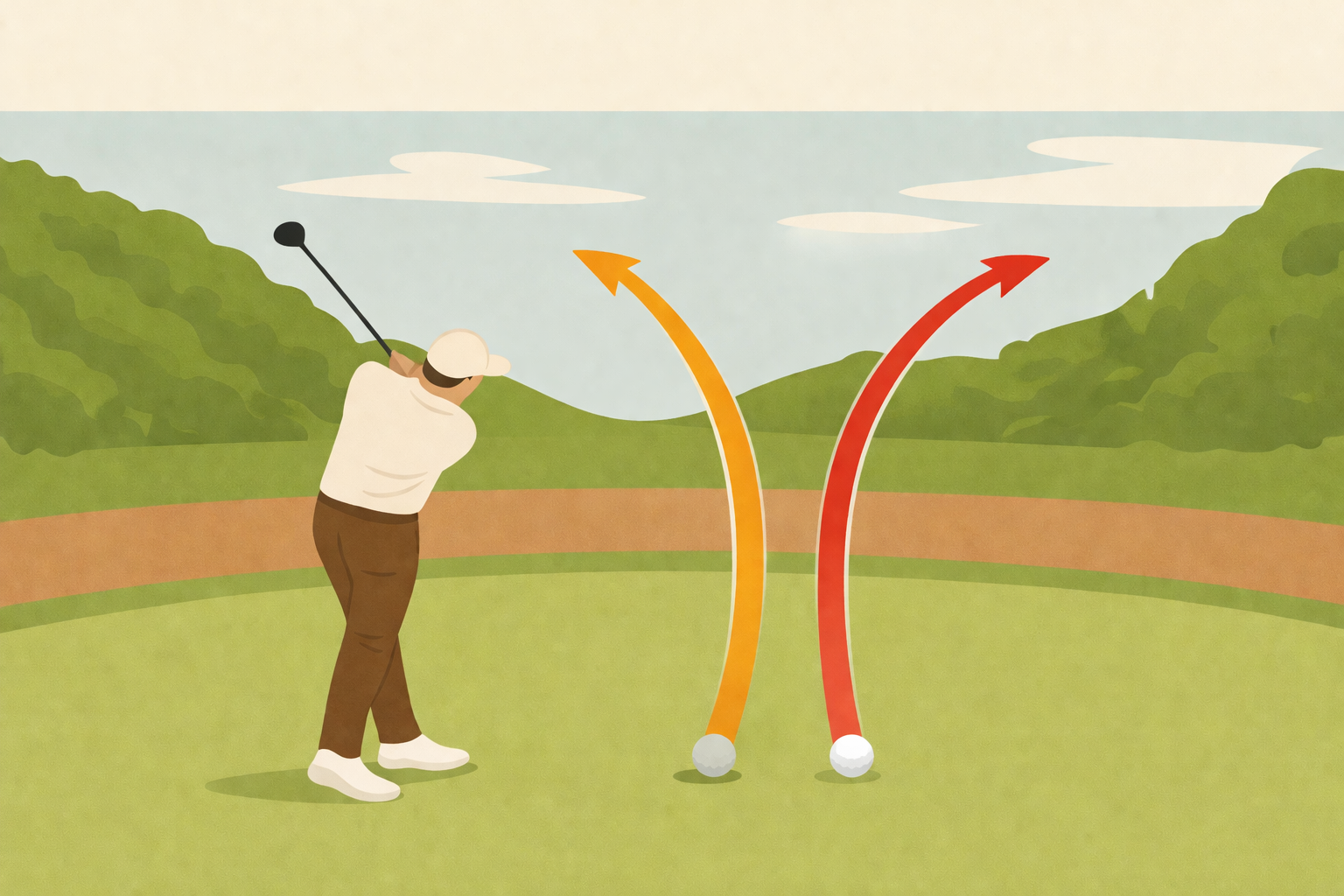
If your shots keep curving wildly—either peeling off to the right or snapping left—you’re dealing with two of the most common miss patterns in golf: a slice and a hook.
One feels weak and out of control. The other feels powerful but unpredictable. Both cost you accuracy, distance, and confidence.
In this guide, you’ll get a clear explanation of slice vs hook, what each one means in your swing, and exactly how to start fixing them.
What’s Causing This Problem?
Both a slice and a hook come from the same core issue: the relationship between your clubface and your swing path at impact.
Here’s what’s happening:
- Slice (curves right for right-handers)
- Clubface is open relative to the path
- Swing path is often outside-in
- Ball starts left or straight, then curves right
- Hook (curves left for right-handers)
- Clubface is closed relative to the path
- Swing path is often inside-out
- Ball starts right or straight, then curves left
- The real cause: face vs path mismatch
The bigger the difference between face and path, the more the ball curves. - Poor grip and release
Weak grip → slice tendency
Over-strong grip or aggressive release → hook tendency - Timing issues
Late release → open face (slice)
Early release → closed face (hook)
If you’re unsure about your slice specifically, this breakdown of the causes of a golf slice will help.
How to Fix It (Step-by-Step)
1. Identify Your Miss First
Don’t guess—watch your ball flight.
What to look for:
- Starts left, curves right → slice
- Starts right, curves left → hook
- Starts straight, curves → face/path mismatch
Why it matters:
You can’t fix what you don’t correctly diagnose.
2. Fix Clubface Control
This is the priority for both shots.
For a slice:
- Strengthen your grip slightly
- Feel the face closing through impact
For a hook:
- Neutralise your grip
- Feel more passive hands through impact
Checkpoint:
Ball should start closer to your intended line.
If needed, work on how to square the clubface at impact.
3. Adjust Your Swing Path
Now match the path to the face.
For a slice:
- Feel like you swing more from inside
- Keep your trail elbow tucked
- Rotate your body through the shot
If this is your issue, learn how to fix an outside-in swing.
For a hook:
- Feel like you swing more neutral
- Avoid dropping too far inside
- Keep your chest rotating through impact
4. Match Face and Path
This is where consistency comes from.
What to aim for:
- Face slightly closed to target but square to path → draw
- Face square to target and path → straight shot
Key feel:
The face should not be dramatically open or closed relative to the path.
5. Build a Repeatable Pattern
Consistency beats perfect swings.
What to do:
- Stick to one feel
- Use drills to reinforce it
- Avoid constant swing changes
If slicing is your main issue, follow this guide to fix a golf slice.
Simple Drills That Actually Work
1. Towel Drill (Connection and Path)
How to do it:
- Place a towel under your lead arm
- Make controlled swings keeping it in place
What it fixes:
Stops over-the-top moves that cause slices.
Learn how to use the towel drill for fixing a slice.
2. Alignment Stick Drill (Path Control)
How to do it:
- Place a stick just outside the ball
- Swing without hitting it
What it fixes:
Improves swing direction and prevents cutting across.
Use this alignment stick drill to fix a slice.
3. Release Drill (Face Control)
How to do it:
- Hit short shots focusing on rolling the forearms
- Feel the clubface square naturally
What it fixes:
Improves face control and timing.
Common Mistakes to Avoid
- Trying to “fix both” at once
Focus on your dominant miss first. - Overcorrecting the grip
Too strong or too weak creates the opposite problem. - Ignoring ball flight feedback
Your ball tells you exactly what’s happening. - Swinging harder to fix it
Speed exaggerates curvature. - Changing drills too often
Stick with one method long enough to see results.
Recommended Equipment (That Actually Helps)
1. Adjustable Drivers
Useful for both slices and hooks.
- Adjust face angle and weighting
- Fine-tune ball flight
- Improve forgiveness
See the best drivers for slicers.
2. Low-Spin Golf Balls
Help reduce curvature in both directions.
- Less sidespin
- More stable flight
- Better control
Explore the best golf balls for slicers.
3. Swing Training Aids
Help you feel the correct movement.
- Improve face awareness
- Reinforce path changes
- Provide instant feedback
Check out the best training aids for fixing a slice.
4. Alignment Sticks
Simple and effective.
- Improve setup
- Guide swing path
- Work across multiple drills
Quick Summary
- A slice curves right; a hook curves left (for right-handers)
- Both come from face and path mismatch
- Face control is the priority
- Path adjustments refine the shot shape
- Drills help build consistency
- Equipment can reduce extremes while you improve
FAQs
What is the difference between a slice and a hook?
A slice curves right due to an open face; a hook curves left due to a closed face.
Which is worse: slice or hook?
A slice is more common and often loses more distance. A hook can be more unpredictable.
Can the same golfer hit both a slice and a hook?
Yes. It usually means inconsistent face control and timing.
Why do I slice my driver but hook my irons?
Different setup, swing intent, and club length can change your path and face control. This explains why some golfers slice with driver but not irons.
How do I stop switching between slice and hook?
Focus on neutral grip and consistent face control first. Then stabilise your swing path.
If you struggle when it matters most, here’s how to stop slicing under pressure.