

Introduction
If your ball starts straight and then curves sharply to the right (for a right-handed golfer), you’re dealing with a slice. It’s one of the most common faults in golf—and one of the most costly.
A slice doesn’t just miss fairways. It kills distance, puts you in trouble more often, and forces compensations that make your swing worse over time.
The important thing to understand is this: a slice isn’t random. It comes from a small number of predictable issues in your grip, swing path, and clubface control.
This guide gives you a clear structure to fix it. You’ll understand what’s causing your slice, what to change first, and how to build a swing that produces straighter, more reliable shots.
What Is a Golf Slice?
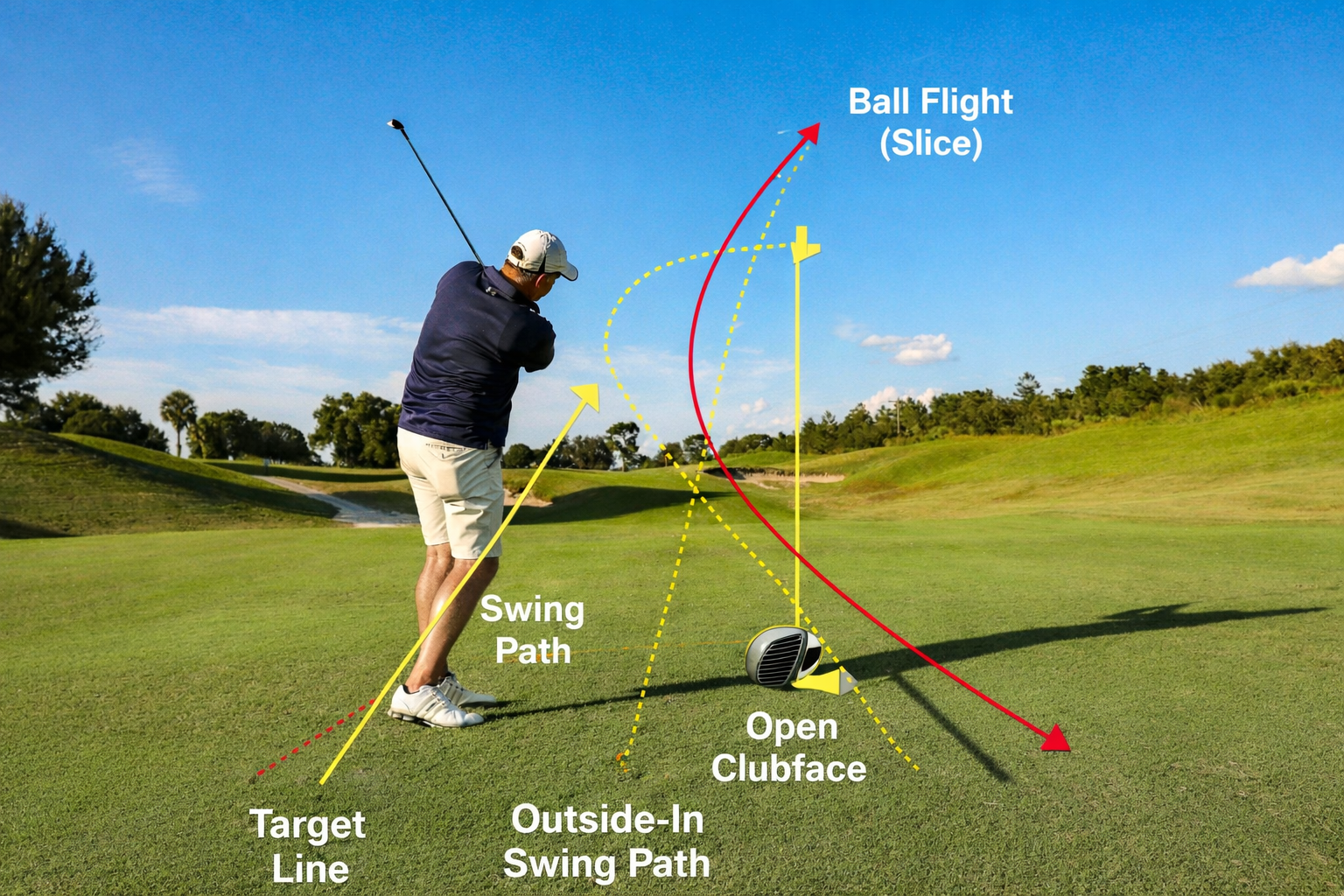
A slice is a shot that curves significantly from left to right (for right-handed golfers).
It happens when the clubface is open relative to your swing path at impact, while the club is moving across the ball from outside to inside. That combination creates sidespin, which sends the ball peeling away from your target.
If you’re not completely clear on ball flights, it’s worth reading a full breakdown of what a slice actually is and how it differs from other shapes like a hook in this guide on what is a golf slice and this comparison of slice vs hook.
What Causes a Golf Slice?
Most golfers are dealing with the same core problems. You don’t need to overhaul everything—you need to identify which of these applies to you.
Common causes:
- Weak grip – hands rotated too far left, making it difficult to square the face
- Open clubface – face pointing right at impact
- Outside-in swing path – the club cuts across the ball
- Poor alignment – aiming left and swinging further left without realising it
- Lack of body rotation – arms dominate the downswing
- Poor sequencing – upper body starts first, forcing an over-the-top move
If you want to properly diagnose your swing, this full breakdown of what causes a golf slice will help you pinpoint the exact issue.
If your typical miss starts right and then curves further right, you’re not just slicing—you’re hitting a push slice, which needs a slightly different fix. This guide on how to fix a push slice walks through that pattern.
How to Fix a Golf Slice (Overview)
Fixing a slice comes down to controlling three things:
- Grip – how the clubface is delivered
- Swing path – how the club moves through the ball
- Clubface angle – what the face is doing at impact
You don’t need a perfect swing. You need to remove the conditions that create sidespin.
In simple terms:
- Strengthen your grip so the face can close naturally
- Improve your swing path so you’re not cutting across the ball
- Learn to square the clubface without forcing it
Everything else builds on those three.
Key Fixes Explained
1. Fix Your Grip
If your grip is weak, the clubface will stay open. That’s why this is always the first place to start.
What to do:
- Rotate both hands slightly to the right on the handle
- Make sure you can see at least 2 knuckles on your lead hand
- Match your trail hand so both “V” shapes point toward your trail shoulder
- Keep your grip pressure relaxed so the club can release
Even a small adjustment here can change your ball flight straight away. If you’re unsure what a correct grip looks like, follow the step-by-step breakdown in this guide on how to fix your slice with a stronger grip.
2. Fix Your Swing Path
An outside-in swing path is one of the biggest reasons the ball curves right.
This usually comes from starting the downswing with your shoulders, which pulls the club over the top.
What to do:
- Start the downswing by shifting pressure into your lead side
- Let the club drop before you rotate your chest
- Keep your trail elbow closer to your body
- Rehearse slower swings with an “in-to-out” feel
You’re not trying to hit a big draw—you’re just removing the steep, across-the-ball motion. If this is your main issue, this guide on how to fix an outside-in swing path breaks it down in more detail.
3. Control the Clubface
Even with a better path, an open clubface will still produce a slice.
Most golfers either hold the face open or try to steer it through impact.
What to do:
- Focus on returning the back of your lead hand square at impact
- Feel the clubface rotating slightly closed through the strike
- Avoid “holding off” the release
- Check your finish—if the face is still open, it will show
This is where a lot of slices actually come from. If you’re unsure what square impact looks like, this guide on how to square the clubface at impact will help.
4. Fix Your Driver Slice
The driver exaggerates everything.
- Longer shaft = harder to control
- Lower loft = more sidespin
- More speed = bigger misses
That’s why many golfers hit irons reasonably well but lose control with the driver.
If that sounds like you, start with this guide on how to fix a slice with a driver. If you specifically slice driver but not irons, this explanation of why you slice your driver but not your irons will make it clear what’s going on. And if your driver slice is noticeably worse than everything else, this guide on why your slice is worse with a driver is worth reading.
5. Fix Your Iron Slice
If you’re slicing irons as well, the issue is more fundamental.
You’re likely dealing with:
- Poor path
- Open clubface
- Weak grip
Irons won’t mask these issues the way a driver sometimes can. This guide on how to fix a slice with irons walks through the key adjustments.
Drills to Improve
You won’t fix a slice just by understanding it. You need to train better movement patterns.
Alignment Stick Drill
Place an alignment stick just outside the ball and make swings without hitting it. If you strike the stick, your path is still too steep and outside-in.
This drill forces a better approach into the ball. You can follow the full setup and variations in this alignment stick slice drill.
Towel Drill
Place a towel under your trail arm and keep it there during your swing. This keeps your arms connected and prevents the over-the-top move.
It’s a simple way to improve sequencing and path. Full instructions are in this towel drill for fixing a slice.
For a more structured approach to practice, work through these drills to fix a slice.
Recommended Equipment
Equipment won’t fix a slice, but it can make your miss less severe while you improve your swing.
What helps:
- Draw-bias drivers – help the face close more easily
- Higher loft (10.5°–12°) – reduces sidespin
- More forgiving golf balls – can reduce curvature slightly
- Training aids – reinforce better movement patterns
If you’re considering equipment changes, start with this guide to the best driver for slicers, then look at the best golf balls for slicers and the most useful training aids to fix a slice.
Common Mistakes
- Trying to swing harder to fix the problem
- Ignoring grip and focusing only on swing mechanics
- Aiming left instead of fixing the root cause
- Overcorrecting and turning a slice into a hook
- Practising without feedback
- Changing too many things at once
Quick Summary
- A slice is caused by an open clubface and an outside-in path
- Fix your grip first—it’s the quickest win
- Improve your swing path by removing the over-the-top move
- Focus on clubface control at impact
- Use drills that give immediate feedback
- Equipment can help, but it won’t fix the cause
FFAQs
Can a golf slice be fixed permanently?
Yes. Once you correct the underlying mechanics and repeat them consistently, the slice becomes predictable and manageable.
Is a slice caused more by grip or swing?
Both matter, but grip is usually the fastest place to improve. A weak grip makes it very difficult to square the face.
Why do I only slice my driver?
The longer shaft, lower loft, and increased speed make it harder to control both face and path. This is explained in more detail here: slice driver but not irons
How long does it take to fix a slice?
Most golfers see improvement within a few focused practice sessions. For a realistic timeline, see this guide on how long it takes to fix a slice.
How do I stop slicing under pressure?
Simplify your focus. Pick one cue—usually grip or tempo—and commit to it. This guide on how to stop slicing under pressure shows how to do that on the course.
Should I change my equipment?
Only after you’ve addressed the fundamentals. Equipment can reduce the severity of the slice, but it won’t remove it.
Related Guides
If you want to go deeper, start with:
- What causes a golf slice?
- How to fix a slice with a driver
- How to fix a slice with irons
- Best driver for slicers
- Drills to fix a slice
Start with your grip, then work on your path, then your clubface. Fix those in that order and your slice will start to disappear.